
Peer Review Process
QUIET journal operates a rigorous double-blind peer-review process, with a minimum of two independent reviewers assessing every manuscript that passes initial editorial screening. The full workflow — from submission to publication — is shown below.
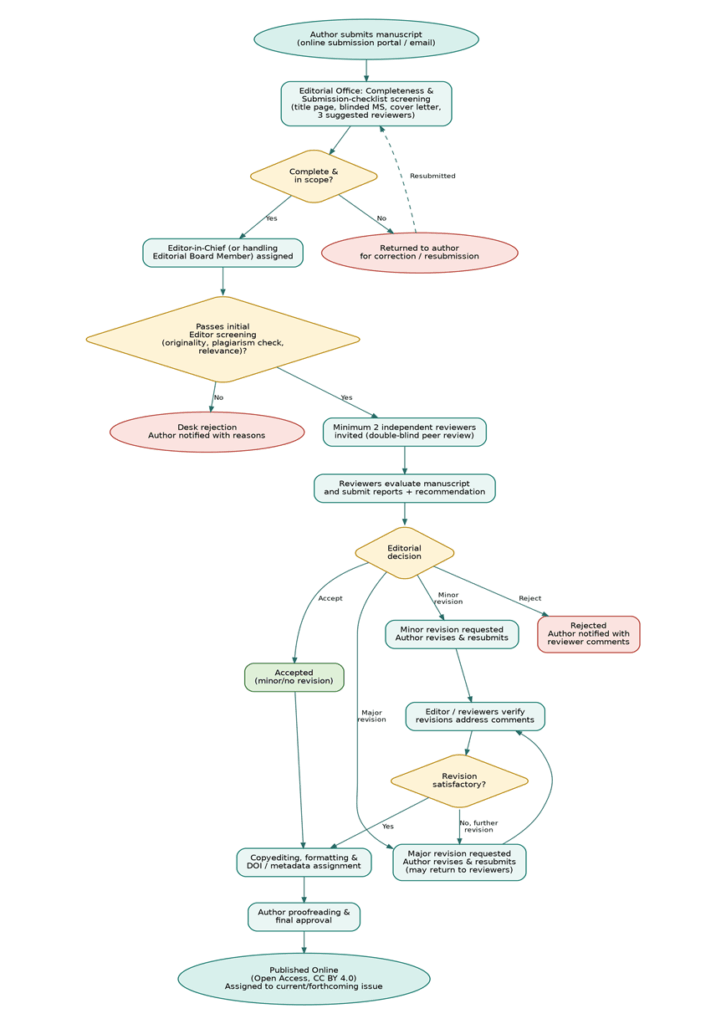
Figure 1. QUIET journal peer-review workflow, from submission to online publication.
Stage-by-Stage Summary
- Submission — author submits via the online portal or email.
- Completeness screening — the Editorial Office checks the submission against the checklist (title page, blinded manuscript, cover letter with 3 suggested reviewers).
- Editor assignment — the Editor-in-Chief or a handling Editorial Board Member is assigned.
- Initial editor screening — originality/plagiarism check and relevance to scope; manuscripts that fail are desk-rejected.
- Reviewer invitation — a minimum of 2 independent reviewers are invited (double-blind).
- Review — reviewers submit written reports and a recommendation (accept, minor revision, major revision, reject).
- Editorial decision — the handling editor makes a decision based on reviewer reports.
- Revision (if requested) — author revises and resubmits; revisions are checked by the editor and, where needed, returned to reviewers.
- Copyediting & DOI assignment — accepted manuscripts are copyedited, formatted, and assigned a DOI.
- Author proof & publication — after author approval, the article is published online (Open Access, CC BY 4.0) and assigned to the current or a forthcoming issue.
Reviewer Guidelines
Reviewers are asked to:
- Evaluate originality, methodological soundness, clarity, and contribution to the field.
- Maintain confidentiality of the manuscript throughout and after the review.
- Declare any conflict of interest and decline to review where one exists.
- Provide constructive, evidence-based comments within the requested timeframe (typically 2–3 weeks).
- Avoid uploading manuscripts to public generative-AI tools (see AI Policy).
Express interest in joining the Reviewer Board
For Editors
Editorial Board Members handling manuscripts are expected to manage the review process impartially, select reviewers with relevant subject expertise, avoid conflicts of interest, ensure timely decisions, and uphold the journal’s ethics and AI policies throughout.
Editorial Policy
- Manuscripts are handled independently of authors’ institutional, geographic, or personal affiliations with the journal.
- Editors and reviewers with a conflict of interest recuse themselves from handling a manuscript.
- All editorial decisions are communicated to authors with supporting reviewer feedback.
- Appeals against editorial decisions may be submitted in writing to the Editor-in-Chief.